PIED FLYCATCHER (Ficedula hypoleuca) - Gobemouche noir
Francesco Varonasi via Wikimedia
SUMMARY
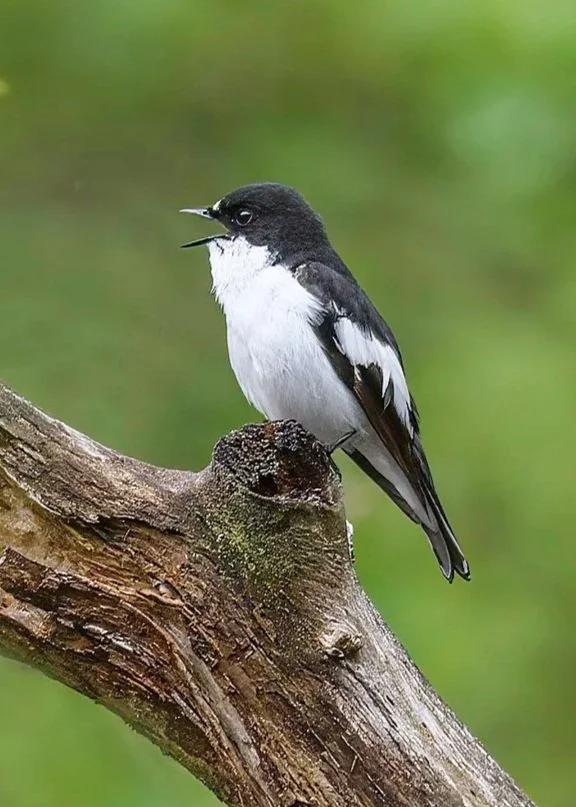
A chunky little bird with shining white breast, dark upper parts, and a distinctive but complex song.

Male Pied Flycatcher (Caroline Legg via Wikimedia)
In his book “Born to Sing”, the philosopher-aesthetician Charles Hartshorn rated 5,000 species of birds across the world and used a consistent assessment of the quality of their song. In this study he assessed 63 “British” birds, and whilst birds like Marsh Warbler, Woodlark, Blackbird and Nightingale scored 6 of his points (the maximum), Pied Flycatcher scored 4 which put them in the class “good” as opposed to “superlative”. A very subjective assessment of course, but nonetheless an interesting approach, and indeed, the Pied Flycatcher has a very pretty little song, which is also extremely complex to follow and understand. It has a slightly harsh or rasping quality, very reminiscent of a Common Redstart. This, along with the males’ bright white breast and pied upper parts, makes me want to watch it all day!
The basic song is a series of pleasant notes, with a slightly coarse edge to them as I say, with occasional repeated elements in each strophe and between strophes - watch out for them in this sonogramme:
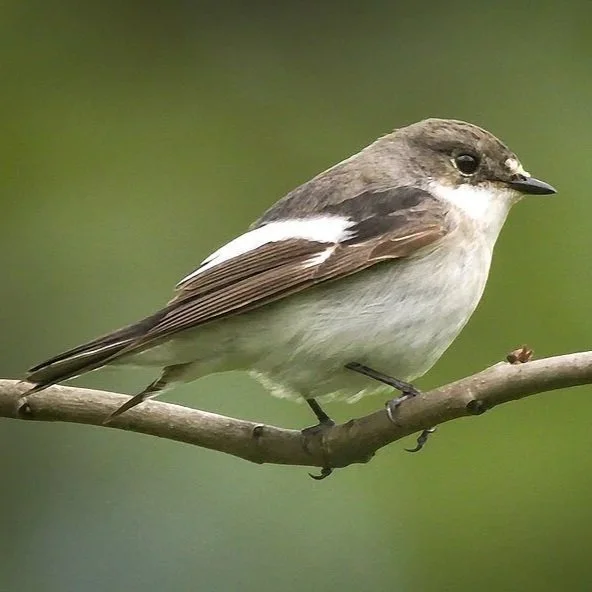
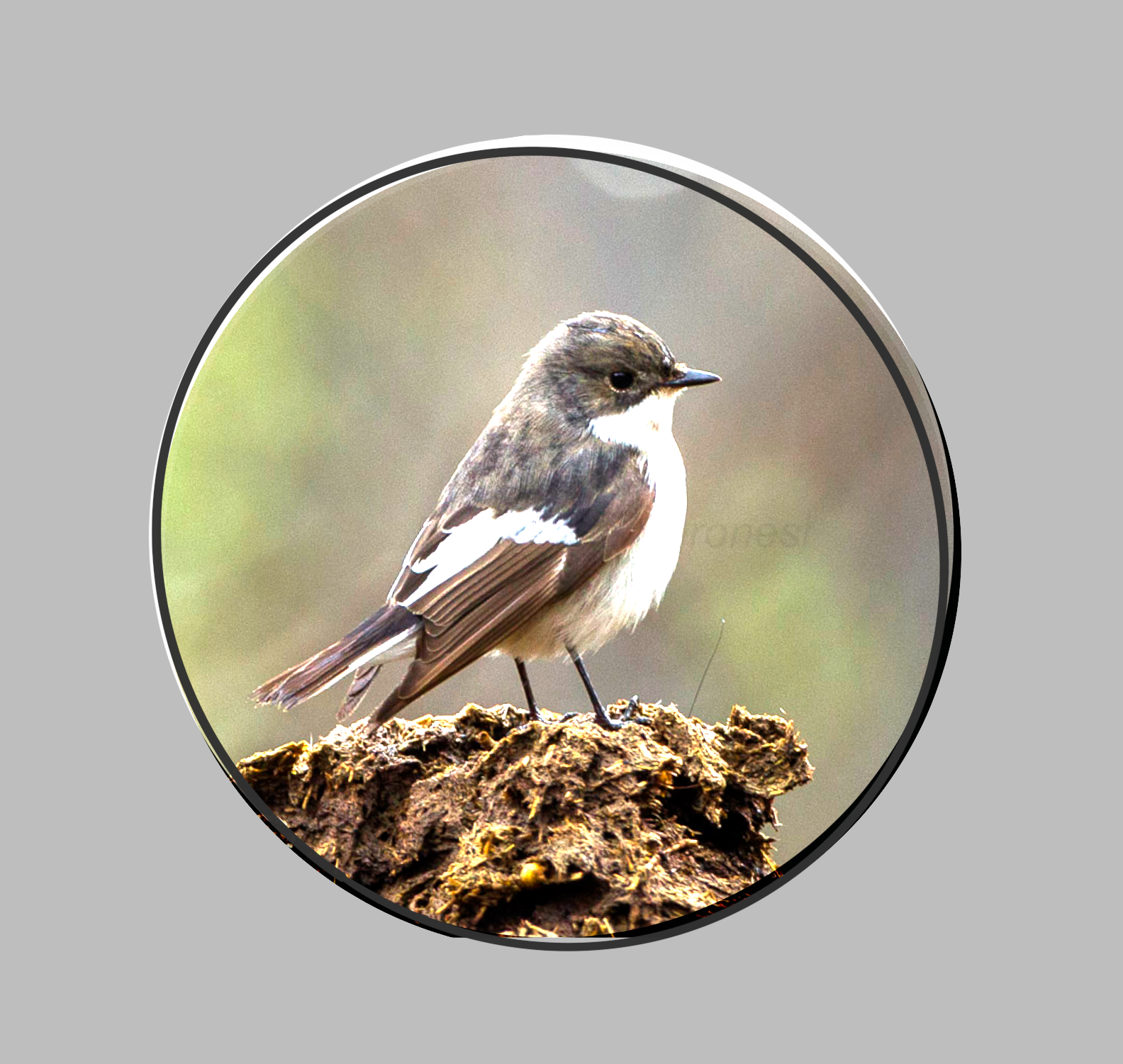
Female Pied Flycatcher (Hedera.Baltica via Wikimedia)
In this simple example you can hear (and see) repeated elements in strophes 1 & 2, and 3 &4; whilst the opening elements, the first two notes of each strophe, are the same in all 4. It is this mixing of elements that makes the song sound familiar. However, is difficult to identify repeated patterns.
The following is a much longer song sequence. You can see this species has a wide frequency range from a low of 2kHz up to 8kHz, each strophe takes about 2 s to deliver, and there is about 6-8 seconds between them. See how many repeated elements there are in here and just where they are placed in each strophe:
A 1m30s sequence of the Pied Flycatcher singing.
Here is a series of strophes from a different bird but you can hear the same pattern of repeated elements in this.
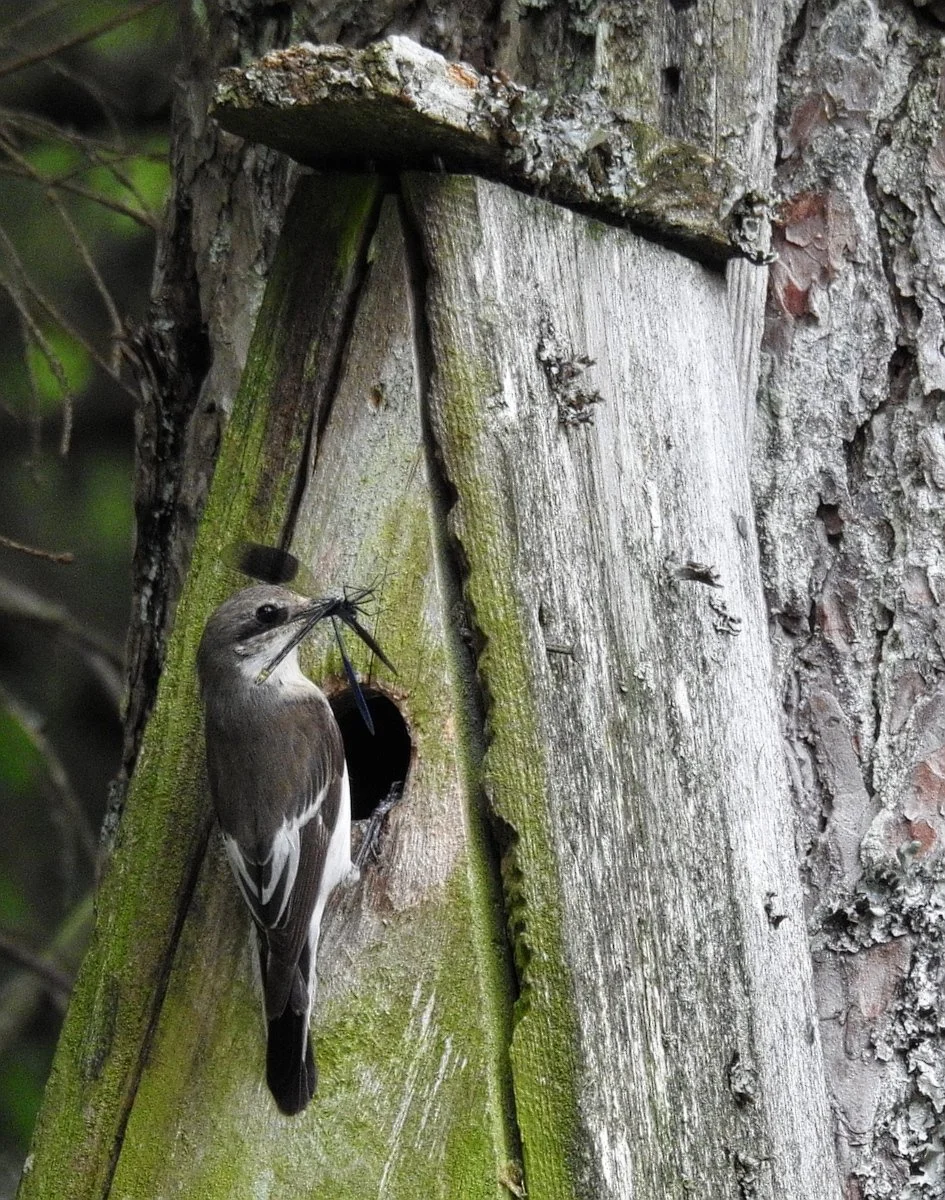
Female Pied Flycatcher at a nest box (Asa Berndtsson via Wikimedia)
So, why do they have such complex songs? Fortunately for us, Pied Flycatchers take readily to nest-boxes and this has meant that, in Scandinavia and Germany, it is has become one of the most studied of the passerines. Whilst we do not understand all, there are some answers to that question which are absolutely fascinating.
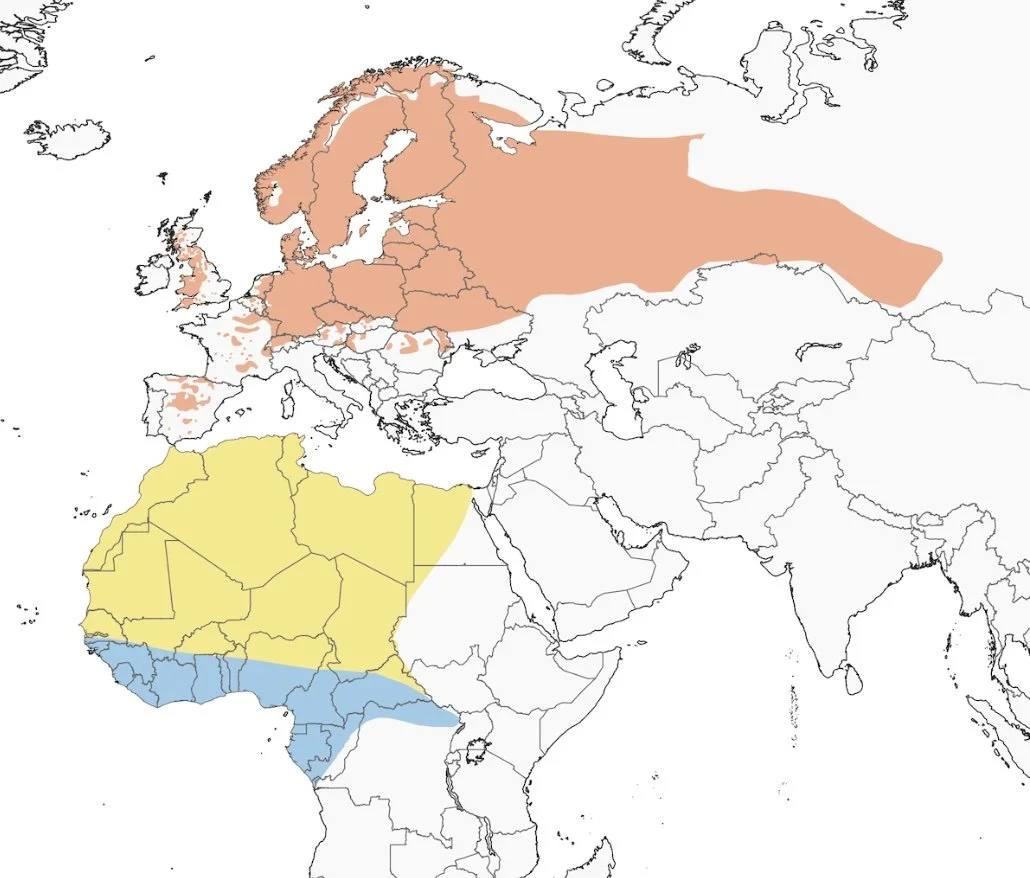
The Pied Flycatcher breeds across north-western Europe (orange) and winters in west and central Africa (blue)
The Pied Flycatcher breeds across north-western Europe and winters in west and central Africa (see map). Male Pied Flycatchers arrive first on the breeding grounds in the European spring (normally April), females following about a week later (Lundberg & Alatalo 1992).
On arrival, the first job of the male is to find a suitable nest hole and attract a female to join him in reproduction. The male does this by singing, but if a female hears his song how does she know that the singer would make a good mate for fertilising her eggs and helping to raise the young successfully? Pied Flycatchers lay 6-7 eggs, and when newly hatched the male has to reliably bring enough food for the female plus young, and later as the young grow the pair have to be able to feed themselves plus a brood of maybe 6 young, that makes 4x the normal amount of food to find and deliver (a normal diet for themselves plus 3 young each). Hence for a female, finding a healthy strong, reliable male is important. If the male can signal this via his song then it enhances the chances of attracting a female.
Pied Flycatchers do this via the complexity of their song. Research has shown that males which are bigger and more experienced in breeding, also have greater variety in their song. Thus they can advertise the qualities that may make them a better parent and pass these strong genes to the offspring, even if the females do not see them at first in thick vegetation (Lampe & Esmark 1994; Lampe& Saetre 1995).
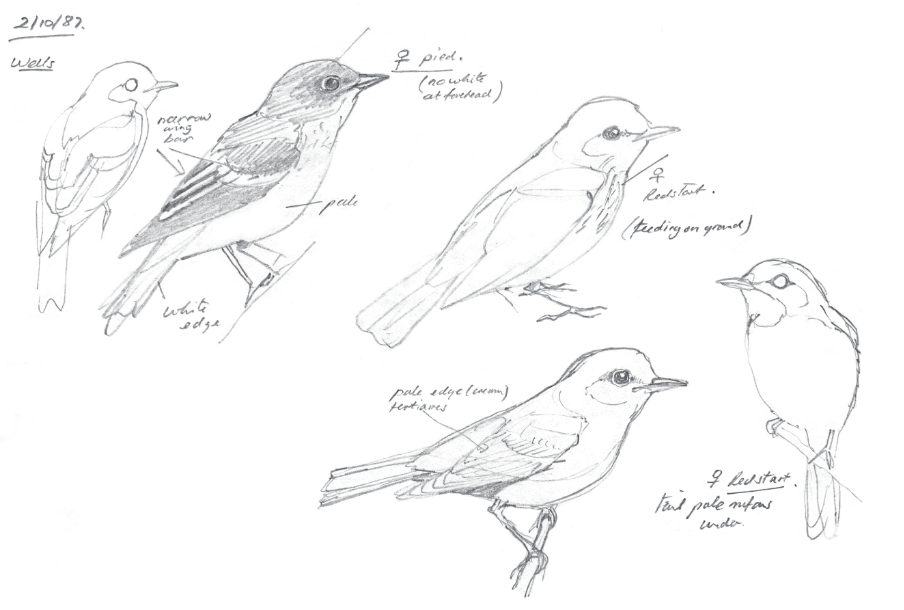
Pied Flycatcher studies by Frank Jarvis
So, attracting a female seems to be the main function of male song in this species. If a female shows interest in his nest hole the male will fly back and forth between nest hole and potential mate using a higher pitched song (Lundberg & Alatalo 1992), but I have not recorded this. Song is also used for territorial defence, but Pied Flycatchers defend very small territories, so this seems to be a secondary function for this species. Supporting this hypothesis is the fact that once mated, male song changes in a number of ways: singing activity is much reduced, plus the song strophes become shorter and simpler. Similar observations have been made for other species (see Kroodsma 1977; Catchpole 1982).
Pied Flycatcher chicks learn song patterns from their fathers even when still in the nest (Labra & Lampe 2018; Wheatcroft etal 2022), and whilst the songs of most species are stable from one year to the next, it is interesting to read that in Pied Flycatchers the songs became more elaborate year-on-year. This suggests that they continue to learn throughout adulthood (Espmark and Lampe 1993) and can convey their parenting experience via their song.
Pied Flycatchers also have a series of short calls which can be used in a variety of circumstances. The most apparent and dramatic one of course is the alarm call, used when there is some threat nearby:
So there you have it, there are many other intriguing aspects of the life of this little bird, more than this page will allow. For more thorough knowledge I would encourage you to track down a copy of Lundberg & Alatalo 1992 “The Pied Flycatcher”, more than 30 years old now but still a great reference.
ACKNOWLEDGEMENTS: I would not have made these recordings without the generosity of Herman Krummenacher who kindly gave me free access to his farm and orchard; his family Goran and Jolanda Krummenacher, who themselves work closely with nature, took much interest in my work, and I spent several happy days in their company. Thank you to you all.
With that I leave you with a longer piece where the Pied Flycatcher (Trauerschnäpper) dominates the scene between the orchard and the river:
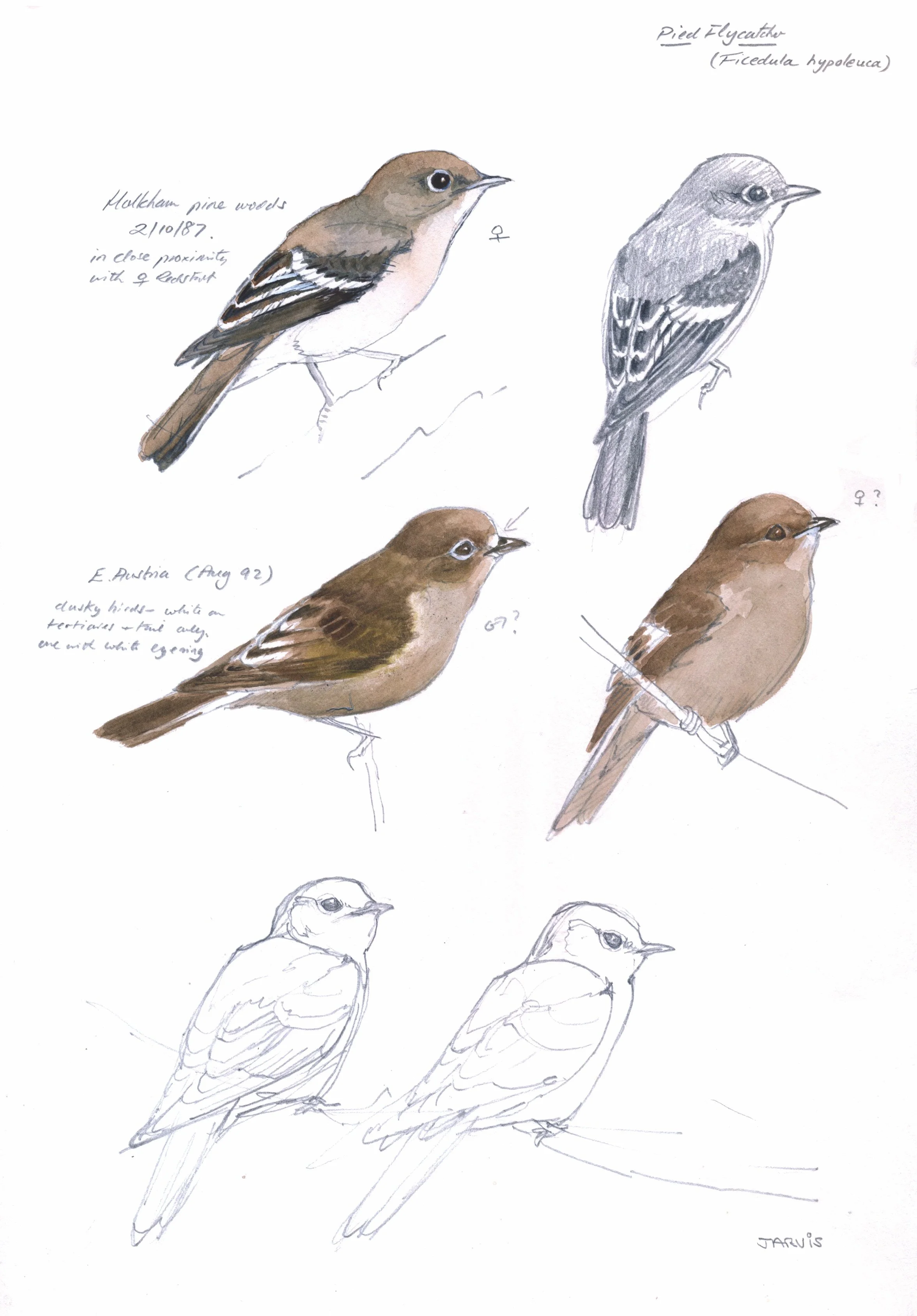
More Pied Flycatcher studies by Frank Jarvis.